Showing posts with label harvest news. Show all posts

Tuesday, August 13, 2019

Harvest In Napa Valley Begins Today With Spectacular Quality Anticipated


Grapes For Sparkling Wines Are First

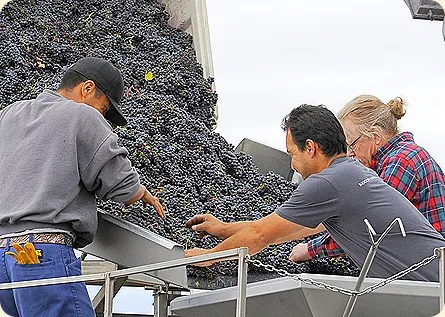
Harvest in Napa Valley typically begins with the sparkling wine producers and Rodgers Vineyard will begin picking Pinot Noir for Mumm Napa Valley today (August 13). Throughout Napa Valley most white varieties will be harvested through the end of August, while the Cabernet Sauvignon harvest will likely begin mid-September.

Keep up with the latest. Follow us on Instagram!

"We have had favorable ripening conditions in Napa Valley over the past 30 days," said Napa Valley Grapegrowers President Paul Goldberg, who is also president of Bettinelli Vineyards. "The very mild, early-season temperatures have led to an incredible growing season."

Heavy Rains Doesn’t Dim Outlook

Heavy rains in March and April cultivated robust cover crops, which organically enriched the soil with an abundance of nutrients. The heavy rain also delayed pruning and bud break by a few weeks in some parts of Napa Valley, but that hasn't had any effect on the overall crop. The rain in April created a bit of shatter in Chardonnay clusters during bloom but didn't significantly reduce crop size. Growers compare it to the same amount of reduction that occurs normally during crop thinning and they call the April rains "nature's way of thinning."

Fruit set was right on course during the spring for Cabernet Sauvignon, Merlot, Petit Verdot, and Malbec. Napa Valley received more rain in May, followed by a heat spike in June, which sparked canopy growth. Since that initial short heat wave, the weather throughout the summer has been moderate and veraison has been "beautiful and even" according to Goldberg. Veraison is an exciting time in the ripening cycle when white grapes transition from green to gold and red grapes transition from green to red, a sign that harvest is just around the corner.

Never Miss A Beat – Follow Vino-Sphere On Facebook

"With the late-season rains, vine growth took off, so crews were still leafing and hedging the vineyards when - boom - it was time for harvest," added Kendall Hoxsey-Onysko, a Napa Valley Grapegrowers board member and the business manager for Yount Mill Vineyards. Yount Mill Vineyards grows five varieties for Mumm Napa Valley: Pinot Meunier; Pinot Noir; Pinot Blanc; Pinot Grigio; and Chardonnay and will harvest their first fruit for Mumm this Saturday, August 17th.

Each year, the Napa Valley Grapegrowers (NVG) hosts the definitive summary on the valley’s harvest and streams it live for thousands of viewers world-wide.  For 43 years NVG has played a vital role in strengthening Napa Valley's reputation as a world-class viticultural region.  Its mission is to preserve and promote Napa Valley’s world-class vineyards.  NVG represents 725 Napa County grapegrowers and associated businesses.

Photos by Sarah Anne Riske

Thursday, March 10, 2016

Early Signs Point To A Stand-Out 2016 Vintage In South Australia

The rare combination of high quality grapes and above average yields in several of Australia’s premier wine regions have growers and winemakers confident the 2016 vintage will be one to remember.


By Andrew Spence

The vintage is in full swing in South Australia’s premier wine regions including the Barossa Valley, McLaren Vale, Clare Valley, Riverland, Adelaide Hills, Eden Valley and Coonawarra.

A warmer than average spring across the state helped strong canopy growth while timely summer rain in many regions in January has led to good yields without impacting on quality.
South Australia is Australia’s largest wine-producing state, accounting for almost half of the national crush.

BAROSSA VALLEY
The Barossa Valley produces world-renowned brands such as Penfolds Grange, Jacob’s Creek and Wolf Blass.

Barossa Grape & Wine Association Viticultural Development Officer Nicki Robins said the 2016 Barossa vintage was shaping as a stand-out, with strong indications of very high quality and yields generally above the five-year average.

“Winemakers are reporting dense color and rich, vibrant flavors in shiraz picked to date,” she said.
“A fortuitous 1.5 inches (40mm) of rain fell from January 21, followed by mild conditions throughout late January/early February, which has seen phenology keeping up with sugar levels in shiraz - lots of brown, crunchy seeds early, yielding rich, ripe tannins.” 

Robins said the mild conditions had also been kind to Barossa Valley whites, including Semillon and chardonnay, which had been building delicate flavors slowly, while retaining crisp acid levels.
Cabernet Sauvignon, Grenache and Mataro in the region are yet to be picked.

Growers have been harvesting Barossa Valley white grapes since late January with chardonnay yields reported to be up to 20 per cent above estimates while Semillon yield is variable, depending on irrigation practices. 

Harvest of Barossa Valley shiraz started around February 10 with close to 50 per cent picked. Yields reported for Shiraz so far have been between average to 20 per cent above the five-year average.

In nearby Eden Valley, shiraz is holding up well, but yields are looking slightly below average. Cabernet sauvignon and Riesling quality and yields are tracking nicely, with potential harvest dates late Feb/early March for Riesling and Viognier, mid/late March for shiraz, and late March/early April for Cabernet Sauvignon.

Yalumba Chief Winemaker Louisa Rose presented her 2016 Barossa Vintage Report at the “Barons of Barossa Declaration of Vintage” ceremony on February 21.

“At this early stage whites are showing delicate but intense flavors and pleasingly good natural acidity, and reds strong colors and rich flavors,” she said.

“Certainly there is nothing in the weather forecast that we can see to slow down the ripening, or take away from the quality of 2016 – which is predicted to be another great Barossa and Eden Valley vintage.”

CLARE VALLEY
The Clare Valley is some 100km north of the Barossa and is best known for producing top quality Riesling and Shiraz.

On February 24, Clare Valley Wine Grape Growers Association Chairman Troy van Dulken said harvest was about halfway through.

He said most vineyards were experiencing above average yields across several varieties.
“Most of the whites are off and about 90 per cent will be picked by the end of next week. The cabernets and things like that will start coming off next week,” he said.

“It’s been a very good season, the heat we’ve just had across the weekend has just finished the shiraz fruit off nicely … I’m really happy with the quality of the shiraz that’s coming into the winery at the moment and I think that’s across the valley.
“It’s one of those rare years where we’re getting a few extra tonnes of fruit and the quality is pretty solid as well.”

Van Dulken said the Riesling yield was also slightly above average and was of “good solid quality” without being an outstanding year such as 2002.

“There’s good flavors there and good acid as well so at this stage we’re quite happy with the Riesling.
“Overall it’s been not quite a perfect vintage but it’s pretty close.” 

MCLAREN VALE
White grapes – spearheaded by chardonnay - and a large amount of shiraz has been harvested in McLaren Vale as pickers move on to cabernet sauvignon grapes in the region about 40km south of Adelaide.

Long-time McLaren Vale wine industry stalwart Jock Harvey said strong yields and excellent quality grapes pointed to an outstanding year in the region best known for producing premium shiraz.

He said a warm spring in McLaren Vale resulted in strong canopy growth but a dry December put pressure on irrigation. He said a couple of heat events allowed for an extended veraison followed by a period of background humidity. 

“That’s one of the keys to an outstanding vintage that extended veraison,” Harvey said.
“Once that passed we had 30mm of rain generally across McLaren Vale and what that did is it freshened up the canopies that were starting to look a bit tired and added some berry weight to the bunches which allowed flavor development to progress side by side with sugar accumulation.

“Consequently we’ve got a season where we’ve got very good natural acids, thick skins, quite crunchy and ripe berries and because we’ve had mild conditions in the mid to high 20s generally, we’re developing flavors slowly and the intake of fruit isn’t rushed.”

“We are very excited – growers are reaching their contracted tonnages, which is the first time they’ve done that in a number of years and winemakers are pretty excited about the fruit.”
Harvey said yields were up by about 20 per cent on 2014 and 2015.

“We’re not concerned by that because we’ve also got outstanding quality – it’s just one of those very kind years.

“I think it’s an outstanding year because many winemakers aren’t making any acid adjustments to their ferments, they are going straight in. We’re seeing really good color and texture out of the thick crunchy skins and really good flavor development.

“2012 was a dream year … and this vintage may well eclipse 2012.”

RIVERLAND
The Riverland in the east of South Australia near the banks of the River Murray is the nation’s largest grape producing region contributing almost a quarter of Australia’s annual crush.

Riverland Wine Executive Officer Chris Byrne said picking was about a third of the way through with the chardonnay harvest almost complete and red varieties just getting underway.

“I think the next two or three weeks will be fairly hectic because most of the main varieties of Shiraz, Cabernet Sauvignon and Merlot are coming to maturity at about the same time but despite all the hot weather we’ve had a remarkably good season with very low pest and disease.”

Byrne said at this stage he expected fairly average yields with a total crop of about 425,000 tonnes, 30,000 tonnes less than last year.

“It remains to be seen. Once the reds come in it will be whether or not they’ve got the yield in them – we won’t really know until mid-March.

“But the quality is excellent according to winemakers.”

Byrne said Riverland grape prices were about the same as last year and remained “very unsatisfactory” for growers.

COONAWARRA
Vignerons in the Coonawarra are optimistic about the 2016 vintage, which commenced with the picking of Chardonnay and Pinot Noir for sparkling wines in the first week of February.

However, the flagship variety of the region in South Australia’s South East, cabernet sauvignon, is unlikely to be harvested until at least mid-March.

Coonawarra Grape and Wine Incorporated president Allen Jenkins said the grapes were holding up well.

“Given the dry season, we have really appreciated being able to irrigate with our groundwater,” he said.

“There is no disease, vine leaves are holding up very well, and the berries are developing evenly and are pea size, which is normal for this time of the year.”

He said there had been no significant berry sunburn, despite the occasional hot day.
“We have also done a lot of work, bunch and shoot and leaf thinning to present ideal crop levels, and are optimistic for high quality fruit.

“As to vintage occurring for the cabernet, it depends on how the temperatures evolve over the next six weeks.

“There has been a strong upwelling at the coast off Robe and we’re hopeful that the cold oceans – which are currently 8C colder than off Adelaide, will give us cold nights and a long, cool ripening period.”

ADELAIDE HILLS
A bumper crop in the Adelaide Hills region has winemakers smiling.

Adelaide Hills Wine Region CEO Robin Shaw said most of the whites, including Sauvignon Blanc, chardonnay and Gruner Veltliner, had been picked while shiraz grapes were still a few weeks away.
“The yields are really high, I know that there’s a few grapes for sale out there because people have harvested more than they expected, which is terrific,” she said.

“The reds are looking fantastic but they’re still two or three weeks off for some people ... the whites are also fantastic, I’ve heard some people use the words ‘my perfect Chardonnay grapes’.”

“The ripening season has been excellent and the big drop of rain we had through the hills which we thought was going to be a worry turned out to be a blessing because it gave the grapes a nice drink and we’ve had virtually no disease so that’s why the yields are up because the grapes have been in good condition.

“Everyone seems to be very happy – I see smiles on winemakers’ faces in the middle of vintage and that’s cool.”

Shaw said it was a compressed vintage because several varieties had been ready to pick simultaneously.

“People are scrambling around for machinery and things to put grapes in but aside from that everyone seems happy.”

Photo courtesy The Lead South Australia


Tuesday, March 8, 2016

Greek Wine Harvest: A Typically Interesting Year

Harvest Update by New Wines of Greece


Fortunately for Greek growers and winemakers, harvests in Greece are not subject to the dramatic yearly variations, that many of their neighbors to the north experience. Greece is virtually surrounded by water with one of the largest coastlines in the world, (considering its small size and the 1200+ islands that make it up) and this moderating climatic influence is a major factor in keeping Greek vintages fairly consistent from year to year, as well as an abundance of sunshine and relatively low humidity.

Greece, the third most mountainous in Europe, is also home to a very diverse range of microclimates and soils, which are perfect for producing wines that show a true sense of place. Of course, there are always seasonal differences to contend with every year and 2015 included an atypical amount of rainfall that helped certain regions and challenged the skills of viticulturualists in others.

The main weather conditions to note for 2015 included a relatively mild winter with good levels of rainfall, resulting in a supply of water that helped nourish the vines during the year and fostered development of good leaf foliage and canopy. A mild summer included light rainfall facilitating good maturity for most grape varieties. The initial results indicate complex aromatic white wines and full-bodied red wines with relatively moderate alcohol levels and intense color. During the year, certain regions experienced additional localized rains, hailstorms and the occasional development of mildew, resulting in reduced production in certain areas, although grape quality remained unaffected.

Throughout Greece, production was down by an average of 13% compared to the last 5 years.

Photo Credit: RobW_ via Compfight cc


Thursday, December 17, 2015

Spain's Rioja Region Reports Earliest Harvest In Memory


Wine has been made in Rioja for 2,500 years. This area in the north Spain was the country's first DOCa, the country's top category. It is one of Spain's most important wine regions.

Harvest Time Comes Early

Rioja's regulatory agency, the Control Board, has reported the earliest harvest in memory. The end of normal harvest in the wine region was October 13. While the final verdict is pending, initial results are very positive. This is partly due to the weather in September, which was exceptionally good for grape quality.

A total of 441,180 metric tons of grapes were picked this year of which 426,700 metric tons were approved after discarding excess production. These were used to make 79 million gallons of DO (DenominaciĂłn de Origen) protected wine.

The Rioja grape harvest usually peaks on or near the feast of Our Lady of El Pilar on October 12, but this year practically all the vineyards were picked out by that date. One of the most curious facts about the 2015 harvest is that it took place practically simultaneously across the region with the bulk of the grapes being picked within a four-week period. Normally, the harvest is carried out gradually over nearly two months, starting at the beginning of September in the earliest eastern areas and finishing in October in the areas at the highest altitudes.

Good Weather Bodes Well For 2015 Vintage

After the mid-September ripening poll, the Control Board Technical Service reported that there were "harvest-ready grapes in all of the Region’s areas," and recommended "selective picking, regardless of vineyard location," because ripening rates depended less this year on location than on other factors, such as production load. Good weather throughout the growing cycle provided excellent canopy growth and grapes in top condition, free of pests or disease. The weather also helped balanced ripening across all vineyards, and unhurried, selective picking.

The 2015 harvest brought top quality grapes as a whole, arriving in perfect condition with analytical results which are very suitable for making excellent wines, with an average alcohol content slightly above normal figures. Quality was particularly outstanding in vineyards located in cooler areas with moderate vigor and limited production, often yielding considerably less than the maximum allowable kg/ha rates. Lower berry weight due to a dry spell during the last part of the growing cycle also had a very positive impact, with a better skin-to-pulp ratio —a key quality factor. The Control Board will soon start the approval process —which involves laboratory tests and tastings—  to accurately rate the new wine.

Total grape production surface area in the region for 2015 was 152,884 acres, 825 more than the previous vintage. Of these, 142,978 acres are planted with red grape varieties and 9,906 acres with white grape varieties.


Photo Credits: BronB and prgrisleyco via Compfight cc

Friday, November 13, 2015

Rain Keeps 2016 Vintage On Track In South Australia

Heavy November rain in some of Australia’s leading wine regions has the 2016 vintage on track for a strong harvest.The Barossa and Clare valleys in South Australia received up to 80mm of much-needed rain last week – more than has fallen in the regions in the past two months.

Australia’s 2016 Vintage Promising

Barossa Grape and Wine Association viticultural development officer Nicki Robins said the rain, which ranged from about 1 to 2 inches in her region, had the vines booming.
“Things are looking really good, most people have just finished flowering so things are looking on track. It was certainly lovely to get that good bit of rain, it really helps a lot,” Robins said.
Things are on track for a very good season
“Because we had such a cold winter the vines went very dormant and then we had a few patches of heat which really made the vines push so the amount of canopy growth is quite good compared to the overall amount of rain we’ve had.”
Robins said while many vineyards were irrigated, good winter and spring rainfall was crucial. “You just can’t beat it,” he said.
“The vines are looking very healthy especially after the recent rain and there’s no disease pressure at the moment so things are looking really nice.” 
The Barossa Valley produces world renowned brands such as Penfolds Grange, Jacob’s Creek and Wolf Blass. Harvest traditionally begins with the picking of white wine grapes in late January and finishes with the completion of red grape harvest in late march or early April.
Never Miss A Toledo Wines and Vines Post – Click To Subscribe


South Australia Produces Half of Country’s Wine

According to the International Organization of Vine and Wine, Australia was the world’s seventh largest wine producing nation in 2015. Italy, France and Spain topped the list.
South Australia is consistently responsible for almost 50 per cent of Australia’s annual production.
Clare Valley Wine Grape Growers Association President Troy van Dulken said vineyards in his region received between 2 and 3.3 inches of rain last week, which was “spot on timing”.
“We’ve had really solid early growth because of the warm spring and with the rain it couldn’t be better,” he said.
“The crop load this year is probably the best I’ve seen since 2010 so where looking at probably above average crops of all varieties throughout Clare at the moment.
“Things are on track for a very good season and it looks like we are tracking towards an early vintage at this stage in the early part of February if not the last week of January.”
Further south, the McLaren Vale and Coonawarra districts have received only about 15-20mm of rain in November but growers were still hopeful of a good season.
Coonawarra Grape & Wine Incorporated President Allen Jenkins said a warmer than average October had kept potentially damaging spring frosts in the region at bay this year.
Jenkins said the warm conditions had been perfect for flowering.
He said although the flowering season had come early, cool summer winds off the chilly Southern Ocean often meant harvest of the region’s Cabernet grapes was traditionally not until early April. 
“It’s been a very nice start to the season – it’s been dry – but the lack of rain means that we’ve had no disease pressure.”
“The rain we had last week was just enough to freshen the vines a bit and settle the dust, it didn’t really have much impact.
“We’d be very happy like to see some good rain in early January just before the vines enter the ripening period.”


Early Harvest On The Way

McLaren Vale grape grower and winemaker James Hook, of DJ’s Growers and Lazy Ballerina wines, said the region was preparing for an early vintage.
“We are possibly going to be picking some grapes in January, which is much earlier than average,” he said.
He said dry conditions were unlikely to be detrimental to the harvest because the region had good access to water for irrigation.
However, he said growers would be hoping to avoid prolonged summer heat waves where temperatures topped 95 degrees for long periods.
“The mood is very optimistic,” he said. “People are seeing good potential yields at this stage.” 
Photo Credit (bottom): krossbow via Compfight cc

Technorati Tags: ,


Friday, October 23, 2015

California 2015 Harvest: Light, Early And Exceptional Quality

“This year is only the third time since 1982 that harvest has finished in September, so to say that this is an early season understates the point a bit,” -- Cameron Parry, winemaker for Groth Vineyards & Winery in Napa Valley.

Fourth Straight Year Of Drought

The 2015 year delivered California vintners and growers across the state another stellar vintage.  Despite a lighter crop—compared to last year—from one of the earliest seasons on record, wildfires during harvest in some regions and a fourth year of drought, quality is high across the board.  A mild winter causing early bud break, followed by protracted bloom and unseasonably cool weather in spring, contributed to smaller grape clusters and variable crop size.  An intense, compacted harvest began in July for sparkling wines and some still white wines, and was finished for most wineries by the end of September.  The crop is estimated to be nearly 3.8 million tons, according to industry experts.
“The quality of the 2015 vintage for California statewide is excellent,” said Robert P. (Bobby) Koch, president and CEO of Wine Institute. “After three record harvests, a lighter vintage will not impact our supply of California wines for wine lovers nationwide and throughout the world.”
“Harvest started 10 days or so early in our north and central coast vineyards because of the warm weather and reduced crop size,” said Keith Horn, VP Grape Management for Constellation Brands. “Happily, we harvested superior quality grapes, just a little lighter crop.”
Never Miss A Toledo Wines and Vines Post – Click To Subscribe


2015 Should Be Another Epic Vintage

“This year is only the third time since 1982 that harvest has finished in September, so to say that this is an early season understates the point a bit,” said Cameron Parry, winemaker for Groth Vineyards & Winery in Napa Valley.  “This year lines up fairly well with 1997, one of the other three September finishes. Yields have been down across the board, but this is not surprising, as we are coming off of an unprecedented run of three large harvests (’12, ’13, and ’14). Though there isn’t a lot of it, the quality of the crop this year is exceptional.  All the Cabernet ferments are showing big, rich, ripe fruit in great balance with the tannins, and the color metrics are off the chart this season.  2015 should prove to be another in an epic string of superior quality vintages.”
“This year was the earliest harvest in my 46 years as a winegrower,” said Richard Sanford, owner of Alma Rosa Winery & Vineyards in Santa Barbara County, primarily producers of Pinot Noir and Chardonnay. “We began on August 10 and were finished by September 8. Others in our area have experienced similar early ripening. The tonnage of grapes is lower than the last two vintage. The quality is superb and will make excellent wine. I would say 2015 is an excellent vintage for wines from the Santa Rita Hills.” 
Tracey Hawkins, co-founder of Hawk and Horse Vineyards in Lake County, is also excited about the harvest, in spite of the Valley Fire that swept through parts of the region in September. “Lake County has seen an early and slightly light 2015 harvest, with some wineries recording their earliest harvest to date,” said Hawkins.  “It was a hot, dry summer, which made the fruit from this vintage very flavorful—and may account for the lightness and earliness of the vintage. Most report tonnage approximately 10 percent lighter than usual, however, others report slightly larger than normal tonnages. Fruit quality across the board is stellar. Harvest was delayed for some when the Valley Fire struck, but harvest resumed in most areas within four days.”


Smaller Berries And Concentrated Flavors

“The drought clearly had an effect in this 2015 vintage,” stated Montse Reece, winemaker for Pedroncelli Winery in Sonoma County. “This has been an early and light harvest, with smaller berries and concentrated fruit flavors. The high temperatures in August and early September accelerated maturity and picking times. Yields were 20 percent lower on average. I’m seeing mild acids, moderate to low alcohols and intense aromatics in all our varieties. This is a vintage of exceptional quality.”
There was more praise for fruit quality from Aaron Lange, who is in charge of viticulture operations at Lange Twins Family Winery & Vineyards. “The 2015 vintage in the Lodi appellation was early, light, and intense,” said Lange. “The season began almost three full weeks ahead of normal and was complete by the end of September.  Red varietals, like Cabernet Sauvignon, had light yields across the board, mostly due to loose clusters and small berry size. Throughout the season, we worked hard to keep up with the fast-paced harvest to deliver winegrapes to wineries at the optimal time with winemakers loving the concentrated colors and flavors of the fruit."
Photo Credit: dbrooksNY via Compfight cc


Saturday, November 10, 2012

2012 Vintage: A Near Perfect Growing Season for Walla Walla Valley Winemakers


Publisher’s Note: One of the shining stars in the US wine scene is Washington’s Walla Walla Valley. We’ve had a chance to tour their wineries (see our winery reports page) and were impressed with the great quality and value. Looks like another great vintage is on the way.
WALLA WALLA, WA- The consensus among Walla Walla Valley winemakers is that this will be a vintage to remember. According to Duane Wollmuth, executive director, Walla Walla Valley Wine Alliance, “nearly every winemaker I have talked to has said the temperatures and extended lack of rainfall have created near perfect conditions for producing wine grapes. We had three months without rain and plenty of warm temperatures. These late spring and summertime conditions, along with a normal cool down in September and October has produced small berry size, well ripened fruit, and excellent acidity.”
Not only did the year’s growing conditions produce exceptional grape quality, but quantities were up as well. A survey of Walla Walla Vintners found that wineries processed as much as two to three times more than they had in 2011. In fact, early estimates put the Washington State grape harvest up 30% from 2011’s smaller crop.
This comes at an excellent time for Washington wineries as they face rapidly increasing global demand for their wines. According to Wollmuth, “this will create a rare opportunity for our wineries to meet more of the ever increasing demand for the high quality wines our valley has become known for. Of course, we all know that the 2012 vintage wines are still dependent upon what our winemakers in the valley do with these great grapes. I am confident, however, that given their track record for producing great wines, our winemakers will make the most of the high quality grapes grown throughout Washington this year.”
The Walla Walla Valley Wine Alliance is a non-profit wine industry membership organization. More information about the Walla Walla Valley Wine Alliance can be found at www.wallawallawine.com.
Enhanced by Zemanta