Wednesday, February 27, 2019

Scenes From Willamette Valley


We're out on the road right now, visiting one of the nation's great wine regions: Oregon's Willamette Valley. As if having some of the world's most sensational wines wasn't enough, the area is loaded with great attractions including top flight restaurants, great craft beer, cool towns and even a monastery. We'll give a full report in the near future, but in the meanwhile, you can enjoy these photos. The building is the Abbey Road Farm B&B where we're been staying. Yes, that's snow -- a bit unusual for the area, but quite scenic. The rooms are in refurnished grain silos. 

You'll get the full scoop soon. Meanwhile, I've got to locate my snowshoes!

Wednesday, February 20, 2019

Rothschild L’egende Range Delivers Bordeaux Excellence With Affordable Price

The Rothschild family has been associated with the vineyards of Bordeaux since 1868. Best known for wines from their prestigious vineyards, they also produce wines intended for everyday drinking.

From A Legendary Family


On 8 August 1868, Baron James de Rothschild purchased Château Lafite, an estate with a vineyard first planted in the late 1600s. Starting in the 1960s, three more château were purchased (in Pauillac, Sauternes and Pomerol).


Expansion of the Rothschild wine enterprise moved beyond Bordeaux with wineries in Chile, Southern France and Argentina. Since 2008, Rothschild has been developing a vineyard in the Penglai region of China.

While best known for producing stellar Bordeaux wines with prices that can soar into the thousands, Domaines Barons de Rothschild has also produced a pair of very affordable labels since 1995. We recently tasted a pair of wines from their L’egende range.

Bordeaux Within Reach


I’m often surprised by friends who will plop down $15 to $20 for a middling, mass-produced California wine, while overlooking some great values from Europe and France in particular. France produces wines in all price categories and often the quality is far above an inexpensive domestic wine.


When you can score a Bordeaux for under $25 produced by the family that produces some of France’s greatest wines, that’s a victory. We sampled the L’egende Bordeaux Rouge 2016, which retails for about $17, and the L’egende Medoc 2016, which lists for about $24.

Actually, I wasn’t expecting much when we opened the Bordeaux. After the first few sips, it was clear that this was an elegant and eminently enjoyable wine. The wine is a 60% Cabernet – 40% Merlot blend and is packed with fresh fruit and well rounded flavors of  raspberry and currants. Forty percent of the wine gets oak aging to lend a touch of toastiness. The finish is long and very smooth.

The Medoc was opened during a wine tasting party at our house. We featured three red blends that we tasted blind. In addition I brought out several special bottles for the group to try, including the L’egende Medoc. The Medoc was a hit with all the guests and one rated it above wines costing much more.

The blend for the Medoc is the same 60% Cab and 40% Merlot. However, there is a noticeable increase in complexity. Fifty percent of the wine gets oak aging and the wine has hints of vanilla and toast. This L’egende is also wonderfully drinkable, with red fruit notes and a touch of spice as well. Both wines are silky smooth.

Bordeaux Blanc, Pauillac and Saint-Emilion are also part of the L’egende range. Each sounds like a good buy.

L’egende is a good glass of Bordeaux – suitable for everyday drinking or a nice dinner. Affordability and charm are no myth as you will discover if you explore the L’egende.

Full disclosure: We received this wine as a media sample

Technorati Tags: ,,

Monday, February 18, 2019

Australia Vacation: Queensland And The Great Barrier Reef

Australia’s Queensland is called the Sunshine State. The Great Barrier Reef was a highlight of our recent visit.

A Visit To Paradise


After exploring Melbourne and the Yarra Valley, we embarked on the second leg our Australian adventure. Hopping a flight to Cairns (pronounced Cans by the Australians) we were soon were headed to the beach destination of Palm Cove.

Pancakes and smoothies at Espresso and Co. in Palm Cove
We stayed at Paradise on the Beach, a place we thoroughly enjoyed. This 34-unit hotel is in the heart of Palm Cove, right on the beach front. Our room had a balcony overlooking the pool and some giant Melaleuca trees.


When we went for a dip in the pool, we heard a peculiar cackling call from a bird in a towering tree. It was a Laughing Kookaburra, an iconic Australian bird that is the largest of the kingfisher family. It serenaded (or laughed at) us during our entire visit.

Not only could we stroll along the beach, but we were close to excellent dining. Each morning we enjoyed eating at Espresso & Co, a great breakfast joint with outdoor seating, a view of the ocean and beautifully prepared food. One unexpected addition to their pancakes is a scoop of ice cream!

Snapper with coconut curry sauce and
Clare Valley Pinot Gris at Neptune's
We tried a couple of restaurants during our stay most notably Neptune’s. At Neptune’s we sampled a local seafood specialty: Barramundi. Barramundi is native to the waters in northern Australia all the way up to southeast Asia and India. Neptune’s has a nice upscale, funky vibe and is just steps away from the beach – perfect for viewing crashing waves of the Coral Sea.


Although we didn’t take advantage of it, Paradise on the Beach has a barbecue grill available for guests. That would have been epic (shrimp on the barbie?).

As much as we enjoyed the accommodations, a key reason we chose it was the location as a staging point for some unique excursions.

The Great Barrier Reef


In my early planning for our Australia trip, I did what you might expect: tried to figure out how many different wine regions we could visit. This however didn’t fly with my wife, who has earned her nickname of Green Dragon. She said we weren’t going to Australia without snorkeling the Great Barrier Reef. She was right, of course.

Our day on the water was orchestrated by Reef Magic Cruises, and they did a nice job. We boarded a large and fast catamaran heading out to the GBR. Green Dragon took some Dramamine to offset any sea sickness. I’ve never had any problems – but then again, it was mighty rough on the water with the water splashing high on the windows and numerous passengers clutching paper bags and darting to the rest rooms.

Inside the submersible
The destination was Marine World, a floating platform that serves as the base of operations for snorkeling, SNUBA or even helicopter rides. Upon arrival we had morning tea and then went onboard the semi-submersible. The semi-submersible doesn’t go entirely underwater. Rather, it has a V-shaped hull with windows that goes under the waves. The seating is cramped, as you might expect, but the views are great. It gives you a chance to view the coral and sea life without worrying about swimming against the current.

We also found the submersible superior to the glass bottom boat, which was the next on our agenda. The water was choppy during our visit, and so it was difficult for the ship’s captain to position the boat over items of interest.

Into The Waters


We returned the Marine World to enjoy a buffet lunch. The next step was the most challenging part of the cruise for me – getting into the Lycra dive suit. This is a safety precaution due to marine stingers (AKA stinging jellyfish) in the water. I was first given what appeared to be a child-sized medium suit. After confirming the ridiculousness of the size selection, I wriggled into a new dive suit.

Snorkeler watching fish feeding
Snorkeling (and other activity) is limited to a cordoned off area, in a step designed to limit damage to the reef. There were several resting stations, tethered floats that you could latch on to if you became tired. There is also a staff member on overwatch, carefully viewing all those in the water.

The Great Barrier Reef is the world’s largest structure made by living organisms. It can be seen from space and stretches for 1,400 miles. Unfortunately, it is under siege from pollution and warming ocean temperatures.

Where The Heck Are My Photos?


For our underwater adventure, Green Dragon had purchased an underwater camera. It was the first time using it, but I had taken a few snaps on dry land to make sure it worked properly.

As we snorkeled along, I was snapping like crazy, taking what I felt were epic shots. Angelfish, Butterflyfish, the giant Wrasse, surgeon fish and a slew of other colorful fish darted by. Underwater was a palette of blues and greens accented with the yellows, blues, orange and blacks of the fish. The coral shows great diversity with some very cool brain coral and the occasional staghorn and elkhorn corals. Click, click, click.

When we finally surfaced, I went to the camera to view my works of art. WHAT! There was nothing, nada. I hadn’t realized that the camera had an automatic shutoff. It’s a bit tricky getting a good shot underwater. We were kicking our swim fins against the current, I was hanging on to Green Dragon and then I was trying to catch photos with the camera dangling on my wrist.

I turned around and went back for another dive -- making darn sure  that I could see the shot on the screen clearly before clicking. I wish I had some of my earlier shots, but came away with another great swim and some excellent shots to boot.

Back on Marine World we went up to the sundeck. Around us the waters varied in shades of sapphire blue and lighter aqua where the reefs approached the surface. A nice cooling breeze wafted the Australian flag as we soaked up the sun before boarding the catamaran for our return trip.

The Great Barrier Reef is one of the Seven Wonders of the Natural World. Depending on your excursion, it also comes with a buffet lunch! We highly recommend visiting this inspiring location.


Friday, February 15, 2019

Australian Winery Visit: Yarra Valley’s Yering Station

Located in the heart of Australia’s Yarra Valley, Yering Station is Victoria’s first vineyard.

Something Old, Something New


Our last stop on our tour of Yarra Valley wineries was Yering Station. In 1838 Victoria’s first vineyard was planted. Although two grape varieties were planted, the area was primarily used for cattle. In the 1850s the property was developed into the largest vineyard in the area.


Yering earned honors for best Victoria vineyard in 1861 and then nabbed the prestigious Grand Prix award at the Universal Exhibition in Paris in 1889.
The golden age for Victoria’s wine industry faded, however and in 1973 the first commercial vintage in 50 years was produced in Yarra Valley. The region was ready for a resurgence. After changing hands several times in the early 1990s, Yering Station was purchased by the Rathbone family in 1996. Yering continues to be a family owned and operated winery.

The wine world’s tastes have changed too. Cool climate wines, such as those produced in Yarra Valley, are prized for their subtle flavors and excellence in Pinot Noir and Chardonnay.

Tasting Heritage


In the historic 1859 building, we climbed upstairs to a private tasting room with exposed wooden beams and a view to the eucalyptus trees and rolling hills of Yarra. We were ready to taste the wines of this historic estate.


Our first wine was unexpected. It was a rosé from 70% Nebbiolo and 30% Sangiovese – a couple of Italian varieties. It’s all estate grown and shows the diversity of grapes in Yarra Valley.

We then moved to some wines for which Yarra Valley is well known: Chardonnay and Pinot Noir. The 2015 Chardonnay has bright and clean flavors of citrus and peach. It is aged in 20% new French oak which lends a nice toasty flavor without being overdone.


Yering Station - Yarra Valley

Yering Station produces five different ranges of Pinot Noir – so there is a wine for every palate and budget. The Yering Station 2017 Pinot Noir retails for AU$40 and has earth notes and flavors of black cherry.

Our tasting continued with the 2017 Village Merlot. Village is the entry range for Yering Station wines and this one seemed a simple one. Great for sipping, but not long on complexity.

The 2017 Yering Station Shiraz Viognier was a sophisticated sip.We’ve always enjoyed Shiraz (or Syrah!) when blended with a touch of Viognier. This is a well-used technique in France’s Rhone region. The Viognier adds nice aromatics and a smooth texture. This is velvety with blackberry flavors and a touch of pepper.

Yering Station is also famed for its Yarrabank sparkling wines, made with Chardonnay and Pinot Noir. Alas, we’ll have to sip those on our next visit.

Yering Station is a landmark in Australia’s wine history. While firmly rooted in the past, the wine continues to earn accolades for its innovative cool climate wines. Be sure to pull into the Station on your next visit to Yarra.

Tuesday, February 12, 2019

Pair Of German Wines Show Dry Defiance


Dry German wines are trending and changing perceptions.

Dry January? How About Dry Wine?


I’m note sure where the concept of Dry January came from, but as a wine writer you can imagine I’m not completely on board. I have in the past abstained from wine during Lent, but it was a challenging 40 days.


A refreshing alternative comes from Germany. Instead of having a dry month, how about some very nice dry wine? That’s an idea we certainly can support. We tried a pair of dry German whites that we found to be outstanding.

The Red Hang


Riesling is one of our favorite grapes and we are partial to the drier style. We tried the 2014 Gunderloch Nackenheimer Rothenberg Riesling Trocken from Rheinhessen. Like many German wines, the long name can appear intimidating, but conveys some important information.


The Rothenberg Vineyard in Nackenheim is on the Rhine River and is on the north end of what is known as the Red Hang. The vineyard is steep, with slopes ranging from 30% to 80% and the soil is made of 290-million-year-old red slate.Trocken indicates that the wine is dry.

The Grunderloch winery has 28 acres that are planted to Riesling, Silvander, Rulander and Gewurztraminer. They produce about 9,000 cases of wine annually.

Inspired is a good description of this wine. Although dry in style, the flavors are not muted. The unique soils lend a nice flowing minerality and a bright acidity creates a crisp finish. The swirling flavors include citrus and apples with a touch of herb. The wine is light gold with green reflections.
This Riesling is a Grosses Gewächs wine. All Grosses Gewächs comes from a Grosses Lage (‘great site’), the best vineyards according to the German VDP classification system. We’ve found “GG” wines to be outstanding.

Weissburgunder Anyone?


That Germany excels in white wine is not a recent discovery. What is relatively new is the increased production of Weissburgunder, known elsewhere as Pinot Blanc. The grape grows in fertile or chalky soil and ripens late. It is a Pinot mutation, sharing genetics with Pinot Noir and Pinot Gris.

In the 1970s, less than 1% of German vines were Weissburgunder. Today that figure is 5%, a noticeable increase. We sampled the 2015 Alexander Laible Weissburgunder from Baden. Baden is the southernmost of Germany’s wine regions.

This was a pleasurable wine to sip. The flavors are subtle peach and white flowers with a dash of herbs. The Laible Weissburgunder is perfect for any light chicken or seafood dish or, as we did, just enjoying in the evening. It is medium bodied and refreshing.

If you have to endure a “dry” month or winter, we suggest that you do it with some dry German white wine!

Wednesday, February 6, 2019

Australian Winery Visit: Yarra Valley’s Rochford Wines

Considered a must-see destination in Yarra Valley, Rochford Wines is a spectacular setting to enjoy award-winning cool-climate wines.

Rochford has outstanding single vineyard Chardonnay

Go Big Or Go Home


Australia’s Yarra Valley is less than an hour from Melbourne, but the contrast is striking. Melbourne’s skyline is dominated by modern architecture and its neighborhood streets closely lined with Victorian houses.

In Yarra Valley, the scenery is filled with flowing hills and valleys. During our visit in January, the fields were painted with the yellows, browns and light greens of Australian winter. Our next stop on our tour was Rochford Wines, a landmark in this famed wine region.


The winery was founded in 1985 as Yarra Vale. In 1992 it was purchased by current owner Helmut Konecsny, who had already established a reputation growing Pinot Noir and Chardonnay. That reputation has been further burnished as Rochford regularly garners top awards for its single vineyard wines.

Rochford is a true destination winery. In addition to the cellar door, there is the acclaimed Isabella’s restaurant, meeting space for any type of special event, and an outdoor amphitheater and facilities capable of hosting concerts for up to 7,000 people. Everything about Rochford is truly first class.

Rochford Wines


Oyster blade of beef at Rochford
We had a couple of stops after the trip from Melbourne, so we were hungry and thirsty when we arrived at Rochford. First things first. We entered into the light and airy restaurant for some lunch.


My dish was new for me, an oyster blade. This is actually a cut of beef below the shoulder blade. It was served crusted in black pepper and coriander with heirloom carrot, almond cream and harissa. Fantastic!

Unfortunately, I was sipping a Rochford Sauvignon Blanc. I thought we’d have a glass of white to be followed by a red. Only one glass was included with our lunch -- and I couldn’t flag down the server to change my wine. That couldn’t detract from the great meal and the Sauvignon Blanc was quite good -- but I longed for the Syrah.

My wife and I ascended the spiral staircase to the top level, where we had an open air view of the winery grounds. After viewing a brief shower from the crow’s nest, we headed to the tasting bar where I opted for the premium tasting.

Cool Climate Mastery


Superb cool climate Chardonnay and Pinot Noir mean there is plenty of great sparkling wine in Yarra Valley. I started with the 2016 Blanc de Blanc. Nutty with a touch of citrus, this is 100% Chardonnay and made in the Methode Traditional. It is sealed with a crown cap which, I’m happy to say, stayed perfectly in place during its trip home in my luggage.

Rochford Blanc de Blanc
Rochford has an impressive lineup of Chardonnay and we sampled a trio from the 2017 vintage. The Dans les Bois Chard has nice grapefruit notes, a smooth texture and a nice pop of oak. The Terre Chardonnay doesn’t get malolactic fermentation and the minerality and acidity are more evident. The latest addition to the Chardonnay family is Isabella’s Vineyard, which retails for AU$75.

The wines we sampled were all 2017 vintage, even though the Rochford wines, including the Chardonnay, can be cellared for years. The reason is China. China is now Australia’s largest wine export market, and they are buying it as fast as Rochford can bottle.

We sampled three Pinot Noirs, the Dans le Bois, Terre and L’Enfant Unique. Yarra Pinot has unique flavors of underbrush, earth, cherry and dark fruit. L’Enfant Unique is unfined and unfiltered and spends 10 months in French oak and time on the lees. It’s a powerful Pinot with notes of spice.

We wrapped up with the Estate Syrah and the Garrigue Heathcote Syrah. This is a rich, dark wine that isn’t fined, and so had sediment. It is whole cluster fermented, adding extra complexity and depth. Grapes are sourced from Victoria’s Heathcote region, renowned for great Syrah. A very nice bottle at AU$86.

Rochford is a great choice for your Yarra Valley wine tasting experience, dining or special event.


Monday, February 4, 2019

Australian Winery Visit: Yarra Valley's Balgownie Estate

Yarra Valley is one of Australia’s leading cold climate regions and the birthplace of Victoria’s wine industry.


Headed To Australian Wine Country


It took us a while to get our feet on the ground after our long journey from North Carolina to Melbourne, Australia. After a day of exploring Magnificent Melbourne and then taking in night matches at the Australian Open, we were ready for some vino.


Our destination was the “place of mists and shadows,” which is a name given by the Wurundjeri people the traditional landowners in the Yarra Valley. The region, located on the eastern outskirts of Melbourne, is a cool growing area known for Pinot Noir, Chardonnay and sparkling wines.

Known as the birthplace of Victoria’s wine industry, its history stretches back to 1838. The first golden age was short-lived and in 1973 the first commercial vintage in 50 years was produced. Now the region shines with quality wines– thanks to a second wave of winemaking pioneers.

Our tour was billed as a Yarra Valley Gourmet tour and our first stop was Yarra Farm Fresh, a farm market where we enjoyed fresh fruit and some refreshing juices including a nice mix of apple juice and ginger. It was a nice pick-me-up on what was shaping up to be a very hot day.

Balgownie Estate


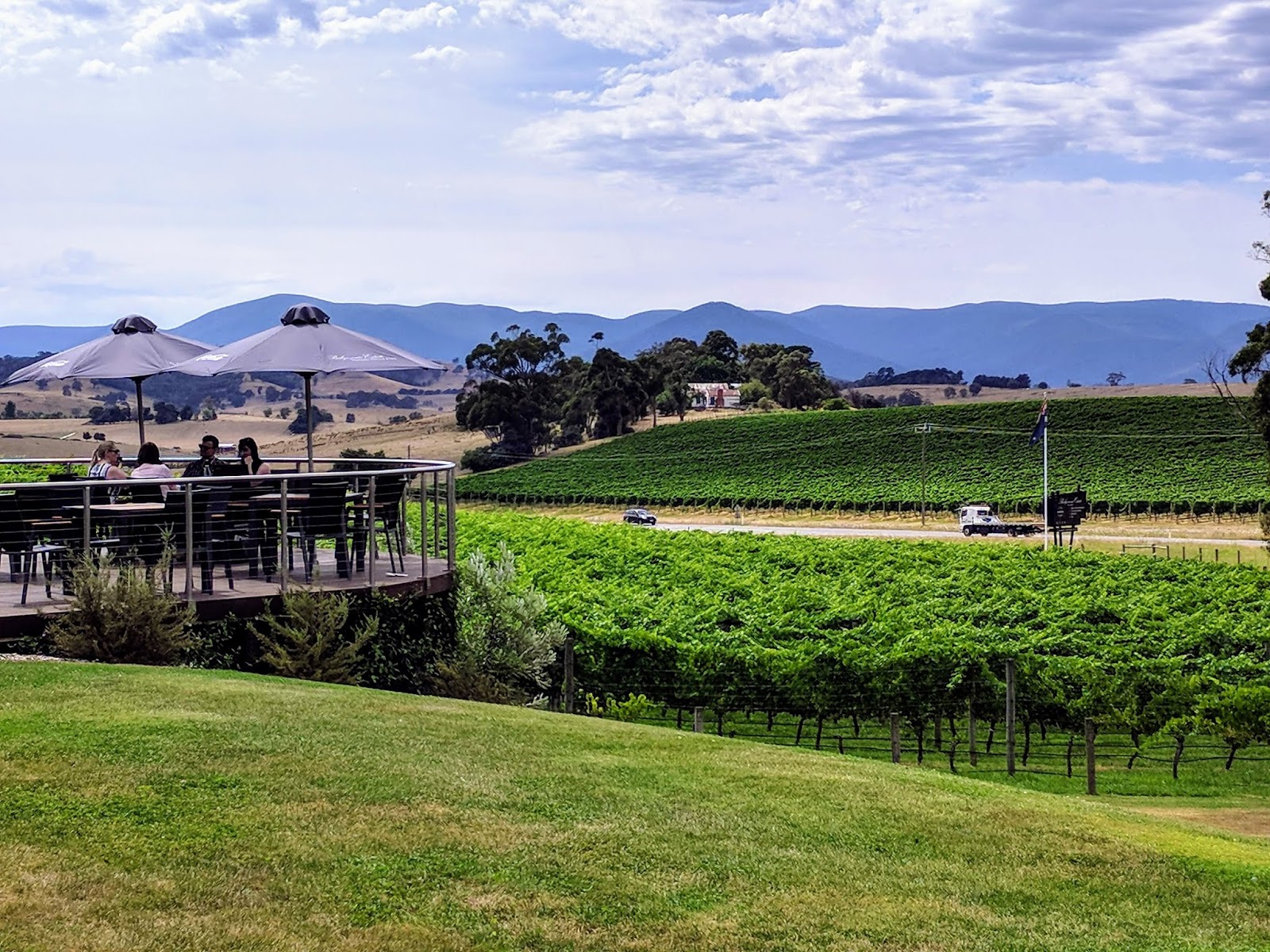
Balgownie Estate was the first winery visit. Their beautiful cellar door (tasting room) overlooks rolling vineyards and the complex features an upscale restaurant, lodging and a day spa.

Never Miss A Beat – Follow Vino-Sphere On Facebook

In Yarra Valley, diverse geography, climate differences and varying soils allow a wide assortment of grape varieties to grow. Balgownie’s Yarra Valley estate vineyards are planted to Chardonnay and Pinot Noir, but their Bendigo estate vineyards, first planted in 1969, are known for their reds.

We opened with the NV Premium Cuvée Brut. This is a sparkler made in the traditional method from mostly Chardonnay and Pinot Noir. A portion is fermented in old oak barrels and gets extended lees contact. Lovely and crisp with tropical fruit and toast notes. Retail AU$21.

The 2016 Black Label Sauvignon Blanc had a burst of the classic aroma of cut grass. On the palate there were bright tropical fruit notes and a splash of passionfruit. The acidity was nicely balanced, midway between a New Zealand Sauvignon and one from California. This is priced at AU$25.


Black Label is the entry range for Balgownie. We tried the Black Label Shiraz (2016) and 2017 Sparkling Shiraz. The Shiraz is light in style with a bit of herbaciousness. It is quite smooth. The 2017 was the first of several sparkling Shiraz we had during the trip. Apparently, this is a popular holiday drink. This one didn’t appeal to me, especially compared to the Cuvée Brut.

The Bendigo Estate Cabernet Sauvignon and Shiraz (both 2015 vintage) were a significant step up in quality and complexity. Selling for AU$45, they come from vineyards planted almost 50 years ago. The Shiraz is light in style with blueberry and plum notes and flowing tannins. The Cabernet is rich and medium bodied with a touch of oak and earth.

For the first time, Balgownie produced a Cabernet Franc in 2017. They blended it with a small amount of Syrah (interesting that they didn’t call it Shiraz). The majority of the wine was aged in used French oak barriques with 5% being aged in new oak. I’m a Cab Franc fanatic, and so we purchased a bottle for AU$29 (or about $21 US). It was a tasty deal that travelled back home in our luggage.

Yarra Valley and Balgownie should be a stop on your next visit “down under.”