Showing posts with label Rias Baixas. Show all posts

Thursday, June 7, 2018

González Byass Wines Offer Spanish Refreshment For Summer

The “lighter side” of Spain is perfect for warm weather sipping.

Heavy Reds Need Not Apply


Blockbuster reds with tightly wound tannins and booming alcohol levels have their place. It’s just not on the patio as the mercury climbs past 90 with the humidity level close behind.


That’s the time when the sensible person opens a light, crisp white or rosé. González Byass is a family-owned collection of wineries that cover Spain’s most important wine producing regions. We recently had a chance to pop open four of their wines well suited for the summer heat.

The González family has a tradition of making fine sherries and brandies in Jerez, including the well-known Tio Pepe Fino Sherry. Tio Pepe sherry has been produced since 1844. Don’t confuse this with the brown, sweet sherry sipped by your grandmother. Fino sherry is dry and should be chilled and served like a white wine. The Tio Pepe Fino Sherry is fresh and bright with notes of citrus and almond. It retails for $19.99.

Three For Dinner


We brought the remaining three bottles to a dinner party at our friends’ house. We started by noshing on melon and prosciutto skewers and homemade guacamole. To accompany this, we opened the Beronia 2017 Rueda. Rueda is known for producing some of the best white wines in Spain.


The Beronia Rueda is made with 100% Verdejo grapes. In the glass it is yellow with green highlights. On the palate it has a lush, rounded texture. There are notes of honey and pear. Although it is a dry wine, it has 1.5% residual sugar, enough to give it a nice sense of fruitiness. SRP is $12.99.

As the main course of chicken with lemon caper sauce was served, we moved to the Pazo de Lusco 2016 Albariño.
Albariño is Spain’s greatest white wine in the opinion of many (including us). The Lusco Albariño comes from Rias Baixas in the country’s northwestern coastal region of Galacia.

This is a beautiful wine with flowing minerality and flavor threads of grapefruit and pineapple. It is a dry and lively wine with good acidity. This is perfect for poultry or seafood. It is priced at $24.99.

A summer party wouldn’t be complete without rosé. We opened the Beronia 2017 Rioja Rosé. A salmon pink color, this wine is made with 100% Tempranillo grapes. Rosé from Spain, often called rosado, tends to be more flavorful than a Provence rosé. Ripples of sweet strawberries and cherries intertwine in this fresh and lively wine. SRP is $12.99. This is a winning wine for almost any occasion.

Spanish sherry, whites and rosé provide perfect warm weather satisfaction. Put on some extra sunscreen and grab one of these affordable bottles!

Full disclosure: We received these wines as marketing samples.

Thursday, May 12, 2016

Six Top Albariño Selections From Spain’s Rías Baixas Region

Rías Baixas, a coastal region in the northwest of Spain, is home to the country’s most famous white grape: Albariño. Here are six picks sure to delight.


How To Enjoy Albariño


In recent months we have been exploring Albariño. This crisp white wine has been perfected in the Rías Baixas DO (Denominación de Origen) of Spain.

During our recent trip to Spain, the greatness of Rías Baixas, in the green fields and rocky coasts of Galicia, was amply demonstrated. The Albariño and local seafood were simply off the charts with excellence.

Back home I’ve had the chance to sample quite a few Albariño courtesy of Rías Baixas Wines and the Wine Studio online education program. When selecting an Albariño, the first step is to ensure it is from Rías Baixas.
There are a few other places (some in Spain and some in Portugal) that produce Albariño, but none do it as well. Wines from Rías Baixas capture the sea spray and granite from their unique locale.

Food is an important part of the Spanish lifestyle, so I’d suggest you have fun with some creative pairings with your Albariño. The Green Dragon prepared an array of creative dishes to go with our Albariño including Crusted Shrimp with Spicy Black Beans and Saffron Sauce and also pulpo (octopus) in a chipotle sauce.


Six Albariño to delight your senses


Adega Eidos, 2014 Eidos de Padriñan DO Rías Baixas – Named after the small family vineyards prevalent in Rías Baixas. Light bodied with mineral notes. Fresh, well-balanced acidity. Lime and tropical fruit.SRP $17.

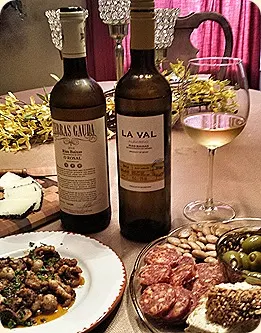
Bodegas La Val, 2014 La Val DO Rías Baixas - Condado do Tea – This is a one-note wine, but that note is very good. Light yellow in the glass, fresh sunshine on the palate. Citrus flavors with a dash of honey. SRP $17.

Bouza do Rei, 2015 Lagar de Bouza DO Rías Baixas – Lightly acidic. Floral and fruity bouquet. A slice of lemon and twist of lime. SRP $16. 

Terras Gauda, 2014 Terras Gauda O Rosal DO Rías Baixas – Shows that a blend (70% Albariño, 20% Loureira, 10% Caiño Blanco) can deliver beautiful complexity. Peach and orange flavor notes with a beautiful honey finish. SRP $24.

Veiga Naum, 2014 Veiga Naum DO Rías Baixas – Awash with lime flavors. Elegant yet bold. Won us over by the end of the evening. SRP $15.

Xion (Attis Bodega y Viñedos) 2014 DO Rías Baixas – A favorite. Golden in color. Stylish and balanced with a primary note of honeysuckle. Nice complexity with luscious acidity. SRP $14.


Technorati Tags: ,,,

Tuesday, April 5, 2016

Morgadio 2013 Legado del Conde Albariño, Rias Baixas


This Albariño hails from Spain’s most celebrated white wine region. So why wasn’t I loving it?

The Spanish Connection


My recent trip to Spain was a blast. Upon my return, we invited some good friends over to enjoy some wine and listen to my tales of the trip. The Green Dragon might put it differently: “Force them to watch an unending slide show of my photos.”

In Spain, the eye-opener was the Albariño from Rias Baixas. This crisp yet flavorful wine was a delight – especially paired with local seafood.

Never Miss A Toledo Wines and Vines Post – Click To Subscribe

A Different Take On Albariño


I grabbed this bottle at Cork’s in Rossford for about $18. There were some less expensive offerings, but this looked very promising. At home we paired it with some shrimp appetizers.

If I hadn’t been sipping some superb Albariño in Spain, I might have loved the Legado. The Vionta Albariño I tasted at the winery had a more pronounced acidity and more complexity. By comparison, the Legado was a bit flat.

The Legado has minimal acidity and more rounded flavors. With a floral nose, it has a soft body and flavors of peach and apple. The wine is thoroughly drinkable, but I prefer more acidity to contrast with the fruit notes. Especially with seafood, the acid provides the balance to the palette of fish flavors.

The Verdict


Over the next several weeks I’ll be sampling a variety of Albariño from Rias Baixas. That will let me become better attuned to the different styles produced from this Spanish grape. Rias Baixas also has sub-districts with unique terroir.

This wine is a good choice for those who prefer softer wines without the bite of acidity. I like my Albariño untamed and this one missed the mark.

Technorati Tags: ,,

Monday, March 28, 2016

A Clean, Crisp Sip Of Spain’s Rías Baixas Wine Region


What’s the most famous wine of Spain? Many Spaniards will tell you it is the Albariño from the Rías Baixas DO.

Shaped By The Land And Sea


Located in the northwest corner of Spain, Galicia is bounded by Portugal to the south and the Atlantic Ocean to the west and north. It has more than 1,000 miles of coastline including islands and inlets (or rías). The character of the water and land has shaped its people and its wine.

Rías Baixas is Spain’s best known white wine DO (Denominación de Origen), but producing the famed drink is no easy task. In the Oceanic climate of Rías Baixas (REE yahs Bī-SHAHS) it rains about 8 months of the year. What happens two weeks before the harvest can have a tremendous impact on the years work. Heavy rains can cause the grapes to burst and become susceptible to disease. Rot can set in in less than 48 hours. Losses of up the 35% are not unknown.

A Wine Of Culture And Relationships


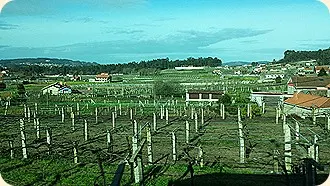
Winding our way from Santiago de Compostela to Bodegas Vionta, small family farms filled the vista.

Each house has its own vines, trellised using pillars made of local granite. In times past, the vines were raised off the ground, allowing farmers to plant potatoes on the ground.

There are 6,700 winegrowers in the region which has only 4,000 hectares. To Bodegas Vionta, a top echelon winery located near Meaño, it means relationships with 50 winegrowers. “It’s part of the culture,” says Pepa Formosa, member of Ferrer Family Wines International Development team. “We always have to buy grapes, but we have to prove what we are doing in the vineyard.”

The Winning Albariño Style


Vionta is named after Isla Vionta, an island off the Atlantic coast that is part of a national park created to protect seabirds. The winery was built in 2002 and was purchased by Ferrer Family Wines in 2014.
The winery has a contemporary look. Large glass windows look over a valley dotted with oak, pine and eucalyptus trees out to the Atlantic.

The prize of the region, and at Vionta, is Albariño. In Rias Baixas, Albariño accounts for 98% of wine production.

It is a grape whose origin is mysterious. Some believe it is related to Riesling and was brought by monk’s making the pilgrimage from Germany’s Mosel region to the Shrine of St. James in Santiago de Compostela. Others suggest that it is indigenous pointing out that Portugal makes fine wines from the same grape.

“Albariño is like horses,” explained Pepa as we tasted a just bottled sample of 2015 Vionta Albariño. “It needs time to calm down.”

Although Albariño is a delicate grape, the soil and the climate give it muscle. The 2015 was perfect in color, but the acidity was a bit untamed. We compared this to the 2014 vintage, which had a rounder texture and a luscious flavor of mango. For the best Albariño experience, go for a vintage one or two years earlier than the current release to allow it to properly develop.

Oceans of Flavor


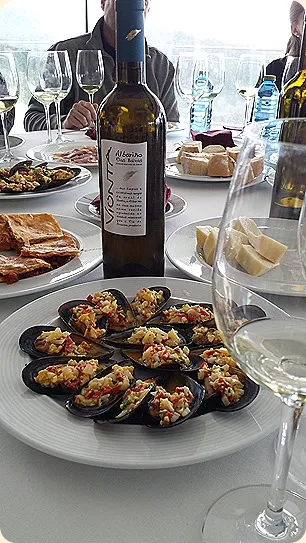
Albariño pairs sublimely with seafood. To fully experience the wine, we enjoyed a light meal of octopus empanada, a potato tortilla, delicious local cow’s milk cheese and mussels.

The mussels were served with a vinaigrette of onion, peppers, garlic, chopped egg, vinegar and olive oil. As is the local custom, they were steamed in sea water. We could gaze out the window and see the inlet where the mussels were farmed.

The Ruedo DO is garnering attention as an up-and-coming white wine region in Spain. Ferrer Family Wines is present in each of Spain’s top wine regions and their Paramus winery produces Verdejo from 15 to 25-year-old vines. We sampled the Paramus Verdejo along with the 2014 and 2015 Vionta Albariño.

The Verdejo has soft, lush flavors with notes of citrus. The spot-on pairing, however, was the 2014 Vionta Albariño and the mussels. The floral aroma, tropical flavors and carefully crafted acidity are memorable.

Rias Baixas has 198 wineries with a focus on Albariño, a great choice instead of Riesling or Sauvignon Blanc. Chances are some of the grapes come from a family farm. Like those farmers, the winemakers of Rias Baixas take pride in what they produce – the best white wine in Spain.