Showing posts with label Petit Verdot. Show all posts

Thursday, May 4, 2023

Virginia Petit Wines Offer Glimpse Of Old Dominion Wine Excellence


Petit Verdot and Petit Manseng showcase Virginia’s award-winning winemaking.    

Four Hundred Years of Winegrowing History

Virginia may seem like an uncommon choice for wine lovers. Not if you’ve had a chance to taste its delicious wines that blend the subtlety of the Old World with the boldness of the new.

Keep up with the latest. Follow us on Instagram!

The state boasts more than 5,000 acres of grapes and has a history that dates back to 1619 when the House of Burgesses passed a law requiring each household to plant 10 grape vines for the purpose of making wine.

Founding father Thomas Jefferson experimented with winemaking and in 1873 a Virginia wine was chosen as the Best Red Wine of All Nations at the Vienna World’s Fair. The wine industry struggled through Prohibition and world wars and in 1979 there were just six wineries in operation. Thankfully for us, wine in Virginia is thriving today.


Never Miss A Beat – Follow Vino-Sphere On Facebook

There are currently more than 300 wineries in Virginia and the quality is better than ever. We recently uncorked bottles from two award-winning Virginia wineries, Jefferson Vineyards, and Veritas Winery, in conjunction with a webinar by the International Food, Wine & Travel Writers Association.

Jefferson Vineyards 2021 Petit Manseng

The site of Jefferson Vineyards was owned by Thomas Jefferson and was later given to Italian viticulturist Filippo Mazzei who formed the Virginia Wine Company. Unfortunately, the vines were later trampled by the horses of a Hessian General during the American Revolution, ruining the labor of four years. In the 1980s vineyards were reestablished and in 1993 the business name was changed to Jefferson Vineyards. Jefferson is recognized for having one of the region’s most consistent records for producing quality wines.

We decided to taste the 2021 Jefferson Petite Manseng with Ricotta Gnudi with Quick Tomato Confit & Fresh Corn. This is a recipe created by Haidar Karoum specifically for Virginia Petit Manseng. I’m told by one of my Italian tennis buddies that the dish is pronounced like “naughty.” This was one of the very best culinary creations we’ve tasted in a while.

It was a perfect match for the Petit Manseng. The wine offers notes of smooth pineapple, white peaches, and honeysuckle. It blended nicely with the ricotta dumplings and cherry tomatoes. The Petite Manseng has no jarring acidity, just a gorgeous, luscious finish.

Veritas 2017 Petit Verdot

For the Veritas 2017 Petit Verdot, we prepared hearty Herb & Garlic Marinated Lamb Chops with Pine Nut Couscous and Broccoli Rabe. My first experience with a single varietal Petit Verdot was many years ago at Flying Fox, a Virginia winery with a family connection to Veritas winemaker Emily Pelton. Although you are more likely to encounter Petit Verdot as a blending ingredient in a Bordeaux-style wine, on its own it shines as a luscious wine.

A 20-year-old family business,  Veritas is on the leading edge of the Virginia wine industry. With over 50 acres in the Monticello wine region, it produces a complex portfolio of wines ranging from sparkling to beautifully balanced red wines.

The Veritas Petit Verdot exudes generous black fruit notes of currant and blackberry whilst smooth tannins and a touch of tobacco create a posh finish. This wine includes 15% Merlot and is aged in 50% new French oak for 16 months.

Full disclosure: These wines were received as part of an educational program.

Friday, January 21, 2022

California’s Historic Livermore Valley Continues To Pioneer Exceptional Wine

Livermore Valley wine continues to make history.

To some Livermore Valley is known as a bedroom community for San Francisco, but to the knowledgeable, the region is well-regarded for its long history of winemaking. It’s one of the oldest wine regions in California and is recognized for introducing grape varieties from Italy, Germany, France, and Spain.

Keep up with the latest. Follow us on Instagram!

Its story began in 1844 when English sailor Robert Livermore planted the area’s first vineyards. Charles Wetmore, then state secretary of viticulture, opened Cresta Blanca winery in 1882. He recognized the valley’s terroir as being similar to the premier vineyards of Bordeaux. In 1889, a dry Livermore Valley white wine from Cresta Blanca won the Grand Prix award at the International Paris Exhibition, becoming the first California wine to win a wine competition in France.

Chardonnay, Cabernet Greatness Starts In Livermore

Two wine pioneers made important contributions that rippled across Livermore Valley, California, and the country. Carl H. Wente and James Concannon purchased prime acreage in Livermore Valley. Wente Vineyards and Concannon Vineyard were established in 1883.

Never Miss A Beat – Follow Vino-Sphere On Facebook

Wente Vineyards is recognized as the pioneer of California Chardonnay. With fruit from the 1936 vintage, Wente released the nation’s first bottling with the varietal name Chardonnay printed on the label. Today Chardonnay is the number one white grape in California and the majority of grapes are Wente clones.

Concannon Vineyard is recognized as the pioneer of California Cabernet Sauvignon and Petite Sirah. In 1961, Concannon introduced America’s first varietally labeled Petite Sirah. Concannon Cabernet clones helped California Cabernet achieve international recognition and are the most widely planted Cabernet clones in the state

Livermore Valley is the closest wine region to the Bay area airports – about an hour away. The AVA also benefits from the cool coastal breeze. That ensures a crisp acidity and allows the grapes to ripen slowly, resulting in good sugar, color, aroma, and flavor complexity.

Livermore Valley Winegrowers Today

Today industry leaders like Wente and Concannon are joined in Livermore Valley by boutique wineries like Omega Road Winery, which produces less than 1,000 cases a year. Alexandra Henkelman, winemaker at Omega Road, describes the appeal of this unique region.

“Livermore is pretty incredible because if you ask all the winemakers here what grows best almost every person will have a different answer because so many things grow so beautifully here in the valley,” said Henkelman. “There's a lot of winemakers who lean towards the Rhone styles versus the Bordeaux styles but again they all have incredible representations.”

We recently sampled two wines from Omega Road and were impressed by the quality. The Omega Road keeps the focus on a fun and enjoyable wine experience. Their lineup includes some unconventional blends and uncommon grapes.

The 2019 Gratia is 70% Sauvignon Blanc, 24% Chardonnay, and 6% Torrontes. It is bright and refreshing with stone fruit notes and floral highlights.

We are huge Petit Verdot fans. The 2019 Omega Road version is 100% Petit Verdot flows with dark fruit flavors of blackberry and blueberry. Dark chocolate touches make this a delightful glass.

Full disclosure: These wines were received as a marketing sample.

Tuesday, June 8, 2021

Clink Different With Unexpected Wine Varieties From Bordeaux And Germany

Germany equals Riesling and Bordeaux means Cabernet and Merlot, right? Not necessarily…

Variety In Varieties

In a world that is increasingly learning to celebrate diversity, it’s surprising how easily we can pigeonhole certain wines or wine regions. It’s not all bad. In many cases, it happens because of skyrocketing success.

Never Miss A Beat – Follow Vino-Sphere On Facebook

Germany is a good example. It’s northerly climate, sloping vineyards, rivers, and slate-filled soil combine to create perfect conditions for the production of Riesling. In Bordeaux, some of the world’s most sublime red wines are produced in chateaus using Cabernet Sauvignon and Merlot.

To focus solely on these grapes, though, is to overlook a bounty of other varieties that thrive in these two regions. Bordeaux and Germany are both cooler climate regions with high quality standards and for the last three years have partnered on a joint marketing effort to showcase their wines. In a recent virtual tasting, four unsung grapes from the two regions were spotlighted.

Weingut Strub 2019 Silvaner Trocken

This wine hails from Germany’s Rheinhessen region, known as the “land of a thousand hills.” It is Germany’s largest wine-growing region in terms of size. Rheinhessen also is home to the world’s largest area devoted to the Silvaner grape, which at one point was the most important grape in Germany.

Keep up with the latest. Follow us on Instagram!

The straw-colored wine opens with aromas of apple, pear, and hay. It provides a surprise on the palate. Far from the shy wine I expected, the wine is rich and a medium-plus in body. The acidity is mild to medium so it didn’t detract from the many layers that emerged, first a green apple flavor emerged followed by vegetal notes wrapped in notes of salinity. There is a waft of sweetness, even though this is a dry wine, but it blends effortlessly into a balanced wine.

We judge this to be an amazing food wine that pairs with grilled or raw fish, salads or stir fry. SRP is $19.

Dourthe 2019 La Grande Cuvée Bordeaux Sauvignon Blanc

While the Bordeaux reds capture most of the world’s attention, don’t sleep on Bordeaux’s white wine. In fact, if teeth-jarring acidity isn’t your thing, you might find the Bordeaux Sauvignon Blanc style more to your liking. Bordeaux, after all, is where this ancient grape originated. The Dourthe Cuvée is 100% Sauvignon Blanc, something that isn’t always a given in a region known for blending.

On the nose, there are fresh notes of citrus. The palate provides a tantalizing sensory experience. The wine is finished in stainless steel and undergoes six months of battonage (stirring on the lees). I always love Chardonnay that is aged in oak and has battonage, but this is the first Sauvignon Blanc we’ve tasted that uses the process. The payoff is huge – rich aromatics, savory flavors, and overall elegance.

The wine is lively with lemon and grapefruit notes mingled with some bread/yeast flavor surrounded by a nice minerality courtesy of the limestone soils. The wine is fresh and has a touch of honey on the finish. This one is perfect for cream-based pasta, fatty fish, steamed clams or goat cheese. Priced at $14.

Schnaitmann 2017 Steinwiege Lemberger

We’ve been on the Lemberger bandwagon for a while now. This grape, also known as Blaufränkisch (and about 50 other names), does really well in cooler regions that we like (such as Germany, Canada, and the Finger Lakes). In Germany, plantings of Lemberger have more than quadrupled since the 1980s. It is grown almost exclusively in Württemberg.

In the glass, the wine has a light purple hue. The aromas hint at what’s to come, with notes of smoke and spice. The tannins are smooth and refined. There are notes of juicy cherries, both sweet and sour. Tobacco and white pepper accents contrast with the fruits. The acidity is medium and the experience is wrapped together with silky mouthfeel and herbal flavors.

Pair this with grilled lamb, chicken shawarma, or tomato-based pasta. Retail is $37.

Château Belle-Vue 2018 Petit Verdot

Our final bottle is a rarity – a 100% old vine Petit Verdot from Bordeaux, where the grape is usually used in blends. The vines range from 62 to 81 years old. Château Belle-Vue was granted the prestigious Cru Bourgeois Exceptionnel status in 2018.

The beauty of this inky grape shines thanks to the use of clay amphora and large (new and used Austrian) oak barrels. The body is silky and almost creamy. In the mouth, it’s all about the blue fruit, with a carousel of violet, blackberry, and floral notes. The finish goes on almost forever.

While this grape is also known as “the little helper" and is often used just to deepen the color of wine, that is changing. Acreage of Petit Verdot has tripled in recent years. The price is $25.

To strike gold, you have to dig below the surface. To discover amazing new wines, you need to think – and clink – differently. These four wines offer an excellent starting point for your next wine exploration.

Full disclosure: These wines were received as a marketing sample.

Thursday, December 10, 2020

Marked Tree 2017 Petit Verdot, North Carolina

Marked Tree 2017 Petit VerdotThink Petit Verdot is just a blending grape? Uncork this bottle and flip the script.

Not So Petite

Those who spend their time thinking or drinking wine, might be surprised with this bottle. At a recent tasting with Arthur Barham, of Merlot2Muscadine, he opened this bottle of Marked Tree 2017 Petit Verdot from North Carolina.

Keep up with the latest. Follow us on Instagram!

Petit Verdot’s main claim to fame is as an important blending grape in France’s Bordeaux wines. It has intense color, beautiful aroma, and good tannic structure. It’s usually 10% or less in red blends – but there are some single varietal bottles out there.

So, this wine is a revelation in a couple of ways. First, it’s a 100% Petit Verdot. Second, if you are not familiar with the great wines made in North Carolina, you might be surprised at the smashing craftsmanship and quality.

Ancient Navigation

Marked Tree Petit Verdot LabelMarked Tree Vineyard is located in Flat Rock on the eastern Continental Divide. It’s in the Crest of the Blue Ridge AVA and situated at an elevation of 2,300 feet. The sloped hills provide good drainage for the vines and the warm days and cool nights allow the grapes sufficient time to develop nuanced flavor and character as they ripen.

Never Miss A Beat – Follow Vino-Sphere On Facebook

Early settlers in the area noticed oddly shaped trees. The trees were formed and shaped by Native Americans to point out water, hunting grounds, a locations of food. The ancient navigation system now points directly to really outstanding wine.

The vineyard’s location and North Carolina’s climate allows the Petit Verdot to ripen more so than in France. The 2017 Petit Verdot is fermented in oak barrels and is a 75-barrel production.

Arthur and I savored this during a rainy, socially-distant tasting. The wine has 12.5% ABV, significantly lower than what you might expect from a bottle of red. To me, that means it can be a great food wine. “Hot” wines with high alcohol content often overpower the delicate flavors of a meal.

In the glass the Marked Tree PV has flavors of blackberry and plum. There is a striking note of minerality that we love plus floral and herbal notes. This wine cries out for an herb-crusted lamb chop! 

We can’t wait to visit this winery and check out their other great wines, including Cabernet Franc and Grüner Veltliner.

Wednesday, September 16, 2020

Petit Verdot Grape Gaining Singular Attention

Long known for its blending attributes, this Bordeaux grape is garnering fans for its single varietal wines.

Celebrating The Grape

Round Peak Petit Verdot Yadkin ValleyIn my home state, August is celebrated as North Carolina Grape Month. As part of the festivities, my friend Arthur Barham, of Merlot2Muscadine, organized a Zoom program in which North Carolina wine influencers each highlighted a favorite grape.

Never Miss A Beat – Follow Vino-Sphere On Facebook

I decided to elevate Petit Verdot. Petit Verdot is one of the six key red varieties of Bordeaux. (Malbec and Carmenere are the ones you might overlook!)

The name means “little green one” in French as it usually struggles to ripen until late in the growing season. Although traditionally reserved as a minor blending component, that dash of Petit Verdot can make all the difference.

Pepper On The Steak

As one winemaker put it, Petit Verdot is like the pepper on the steak. Without the pepper, it is not the same steak. Even 1 or 2 percent can make an obvious difference.

Keep up with the latest. Follow us on Instagram!

Petit Verdot has spread to warmer climates, like North Carolina and Virginia, and winemakers are discovering that Petit Verdot can make bold, intensely fruity wines that can easily stand alone.

My first single varietal Petit Verdot was at Flying Fox Vineyard in Virginia. I came seeking Cabernet Franc and left singing the praises of their delicious Petit Verdot.

In North Carolina, the grape was introduced in the early 2000s and some of the earliest wineries to adopt it were Childress, Shelton, RayLen, and Shadow Springs. The Shadow Springs Petit Verdot I had during our last visit there was, in my estimation, their finest wine.

From Bordeaux To Yadkin Valley

A quick aside about climate change and Bordeaux grapes. Many wine enthusiasts can name the six red grapes of Bordeaux – but that number has grown. Due to climate change, Bordeaux is now allowing new grapes: Touriga Nacional, Marselan, Arinarnoa and Castets. You can expect to see these grapes be introduced gradually, but it shows the inseparable connection between climate and the ability of grapes to thrive.

For the Zoom program, I picked the 2016 Round Peak Petit Verdot, Yadkin Valley. I’ve liked this wine since we tried it at the winery in 2017 and it continues to be a tasty choice.

It has round flavors of sour cherry with a light to medium body. There are traces of smokiness and violets. This is an easy drinking, high QPR (quality price ratio) wine. SRP is $15.

I found my bottle in North Carolina, but I’ve enjoyed single-varietal Petit Verdot from Colorado, Washington, Virginia, and Sonoma too. Australia, Napa, South Africa and South America also produce Petit Verdot.

Are you in a red wine rut of Pinot Noir and Cabernet? Declare your independence with a bottle of Petit Verdot.

Tuesday, June 2, 2020

WIYG–What’s In Your Glass? Here’s What’s In Ours

WIYG? That’s a question we are often asked. Here’s a look at what we’re sipping.


Round Peak Petit VerdotRound Peak 2016 Petit Verdot, North Carolina

Petit Verdot is one of six permitted grapes in the famed red wines of France’s Bordeaux region. It’s rarely the featured star, instead being added into blends for additional body and deeper color. It’s special to find it as a single varietal bottling – so when we see it, we usually buy it.

Never Miss A Beat – Follow Vino-Sphere On Facebook

To celebrate North Carolina Wine Month (May), I picked up this bottle from a local shop. Round Peak is the first winery we visited in North Carolina. We were impressed with the scenery, great tasting room and a wide assortment of wines.

The body on the wine is on the light side of medium. True to the winery name, there is a nice rounded flavor. This is an enjoyable sipper with a tasty sour cherry flavor. SRP is $15.

Becker Vineyards 2013 Indian Summer, Texas

Becker Vineyards 2013 Indian SummerThis is a limited production red blend from Becker, a leading Texas Hill Country winery. It’s a blend of Zinfandel, Cabernet Sauvignon, Merlot and Malbec.

Keep up with the latest. Follow us on Instagram!

Way past its ideal drinking window, there was a plasticky aroma when first opened. After a bit of decanting, the funk dissipated and it turned into a nice mid-bodied wine with delicate flavors of cedar, spice and cherries. We’d like to try another bottle – drinking within one to two years of release would be best.

Villa Bellangelo 2016 Cabernet Franc, Seneca Lake

Bellangelo 2016 Cabernet Franc
The best red wine coming out of New York’s Finger Lakes region is undoubtedly Cabernet Franc. The grape thrives in the sometimes challenging climate of the area that prevents some red varieties from developing depth and intense flavors.

Villa Bellangelo is a premier winery destination on Seneca Lake. While they are known for a wide range of masterful Rieslings, this bottle shows they can produce superb reds as well. Surprisingly, this bottle sells for a mere $18.

This is a rich and flavorful wine with blueberry and raspberry notes. The tannins are gentle. There is a satisfying finish that coats the tongue

As you can see from this week’s wrap-up of wines, there are outstanding wines in your own neighborhood. Local wineries need your support now more than ever as they try to reemerge from the coronavirus lockdown which closed tasting rooms around the country.

Monday, August 27, 2018

Argentina Wine Elegance Delivered By Nieto Senetiner and Ruca Malen

Has Argentine Malbec lost its luster? After sipping bottles from these two producers, we say “no way!”

Dance Of The Grapes


Malbec and Argentina are linked like two dancers in a tango. Each step of the dance and each Malbec grape carries the culture of the Argentine people.


Tango started with the lower classes in Buenos Aires and travelled across the ocean to become a huge hit across the world. Malbec became the “it” wine in the 2000s, propelling Argentina’s wines to new recognition. Has Malbec, and Argentina’s star faded in recent years? We opened bottles from two wineries – founded more than 100 years apart – to get some answers.

Nieto Senetiner Winery Has Tradition Of Quality


Our first bottle to sample was from Nieto Senetiner, a winery founded in 1888 by the first wave of Italian immigrants to Vistalba in the growing area of Luján de Cuyo near Mendoza. Perfectly situated at the best latitude for wine production, Mendoza accounts for more than 70% of Argentina’s vineyard acreage. Don Nicanor Nieto joined forces with his son-in-law Adriano Senetiner in the 1960s to purchase the historic Villa Blanca winery in Vistalba, renaming the venture Nieto Senetiner. Today, the winery encompasses 700 acres of estate vineyards in the DOC region of Luján de Cuyo.


The Don Nicanor 2016 Malbec is a welcome surprise, with added complexity coming from 12 months of aging in French oak and vines with an average age of 30 years. These grapes are grown at 3,100 to 3,400 feet. The wine is round and rich with red fruit and a dash of spice. It is a great value at $18.

The Nieto Senetiner Malbec, at $13 SRP, is no slouch either. On a recent evening we served it along with a pricey Cabernet Sauvignon from Napa Valley. One guest couldn’t stop talking about how good the Malbec was! Vanilla and jam flavor notes are wrapped in smooth-drinking tannins.

Argentina excels in red wine. Malbec is certainly the most well known, but it isn’t alone. Nieto Senetiner 2015 Red Blend Collection is a mix of 55% Malbec, 35% Cabernet Franc and 15% Petit Verdot. 

We enjoyed this with a dinner of Italian eggplant and chicken parmesan. We found it to be a spot-on pairing. It will also go well with grilled beef or stews. There are luscious blackberry and violet flavors with silken textures. Retail is $15.

Boutique Flavors Flow From Ruca Malen


Ruca Malen was founded in 1998 by Jean Pierre Thibaud and Jacques Louis de Montalembert, who have association with France’s foremost winemaking houses. They worked together at Chandon Argentina and wanted to create wines that acknowledged their French heritage while capturing Mendoza's incredible terroir. Ruca Malen translated is “the house of the young girl,” taking its name from a Mapuche Indian legend.  A young tribal woman looked up to the heavens and fell in love with a handsome god. The god gave her a beautiful house, overlooking the world’s splendors.

We enjoyed the “splendors” of Ruca Malen during a wine dinner we hosted. The five course meal featured light and summery dishes and no red wines until the last two courses. For the meat course I fired up the grill to make my signature Mici – a skinless, spicy sausage popular in Romania. It is made with beef, lamb and pork and generous quantities of garlic. We served it on a pretzel roll with locally made German-style mustard and zucchini crisps.

For the pairing we selected the Ruca Malen 2015 Terroir Series Petit Verdot. A 100% Petit Verdot is hard to find, with the grape usually playing a minor role in blends. This bottle shone with bright red fruit flavors, threads of cocoa and hints of oak. At $18, this is an outstanding buy. A great example of other wine that Argentina produces very well.

Our epic wine dinner closed with a berry and chocolate ganache dessert that took decadence to a new level! Clearly this special dessert deserved a unique wine. After polling the guests and determining they didn’t want a sweet white dessert wine, I uncorked the Ruca Malen 2015 Terroir Series Malbec. This is an unconventional pairing. When a wine is this enjoyable, you can shrug off the unwritten rules.

The Terroir Series Malbec uses grapes from the high elevation Uco Valley. It has notes of plum and cherry with a vibrant acidity. The tannins are soft and enjoyable. It’s a young and fresh tasting wine. Retail is $18.

Ruca Malen was recently named “Most Popular Argentinean Wines in America” in a Wine & Spirits restaurant poll. We can understand why. The elegant flavors far surpass what you expect from a sub-$20 bottle.

Argentina and Malbec are alive and well. If you haven’t tried a Malbec or Argentine red for a while, here are two great producers to check out. Do so and your tango dancing will soon improve!


Thursday, May 10, 2018

Shadow Springs Vineyard: North Carolina Winery Visit

Can a wine lover find true happiness in North Carolina? You need look no further than Hamptonville and the estate of Shadow Springs Vineyard.

From Tobacco To Wine Trellises


Shadow Springs Vineyard began more than a decade ago when Chuck and Jamey Johnson planted two acres of Merlot in an old tobacco field. Since then the family owned vineyard has grown to the point where it now boasts eight varieties of estate grown grapes and sells 18 different wines.


During our recent visit to North Carolina’s wine country we visited the Swan Creek AVA. The wineries in Swan Creek are the closest in proximity within the state. We were able to visit five wineries, each no more than five miles apart. We came away from Shadow Springs very impressed.
The 5,000 square-foot tasting room was built in 2007. It is light and airy with beautiful wood finishes and accents of Ambrosia Maple. It’s location overlooks the entire 10.5 acre vineyard and features a downstairs bar, a second floor terrace and a patio near a scenic pond.


Sipping In The Shadows


Jamey was in the tasting room and led us through a line up of their wines. We started with a pair of white wines:

2015 Stainless Steel Chardonnay – Green Dragon prefers her Chard unoaked, so this was a good pick. Green apple and pear.


2015 Barrel Fermented Viognier – Fermented in stainless steel and then aged in neutral oak, it is soft and creamy and not as fruity as most Viognier.

Moving into the reds, we had our eye on a couple of our favorite grapes:

2014 Cabernet Franc – Cab Franc is one of our favorites. The Shadow Springs version has bright cherry with a dash of black pepper. A great buy at only $20.

2013 Chambourcin – Chambourcin is one of our favorite French-American hybrids and, luckily for us, it thrives in NC. This was one of the best wines we tasted on our trip! It is dark and fruity with flavor notes of raspberry and raisin. Excellent finish.

And The Best Wine Is…


We next tasted the 2014 Merlot and the 2011 Reserve Cabernet Sauvignon. Merlot is a strongpoint for wineries in Yadkin Valley (Shadow Springs is in both Yadkin Valley and Swan Creek AVAs) and this version is soft and pleasant. The Reserve Cab is 75% Cabernet Sauvignon and 25% Petit Verdot and is aged in a combination of French, American and Hungarian oak. It is smoky with smooth tannins.

2014 Meritage – We are Meritage lovers! This is a Bordeaux-style blend of Cab Franc, Cabernet Sauvignon, Merlot and Petit Verdot. It gets two years of aging in oak barrels. This robust red was a standout. It is priced at $28.

2014 Petit Verdot – This 100% Petit Verdot is a really good bottle of wine. It is aged two years in new French and America oak. Bright purple in color, it has a medium to full body, with ripe blueberry and herbal flavor threads. This is Shadow Springs’ best wine and runs $35. We bought a bottle and opened it the other night – sensational.

Shadow Springs has what we look for in a winery experience: an excellent tasting room with friendly and knowledgeable staff as well as a variety of really good wines. Make Shadow Springs a destination on your next North Carolina wine excursion.

Monday, November 23, 2015

Colorado Wine Industry Captures Nationwide Attention

The first recorded wine production in Colorado was 1890. Today there are more than 125 licensed wineries – but chances are you’ve never tasted a wine from the Centennial State.

High Altitude Grapes

Four years ago while exploring the Rocky Mountains and visiting family, we had a chance to visit some Colorado wineries. The trip was eye opening.
The winemaking in Colorado is quite sensational, thanks to the high desert climate and unique soil. Even though Colorado’s grape growing regions range in elevation from 4,000 to 7,000 feet, the highest in the Northern Hemisphere, their wine still flies under the radar.
We recently hosted a Colorado wine dinner with the assistance of the Colorado Wine Industry Development Board, giving our group a chance to dig into the wines of this mountainous state.
Check Out Our Winery Reports Page To Plan Your Next Visit!

Bordeaux Varieties Take Root In Colorado

To accompany our meal, we had four wines from three different Colorado wineries:
  • Bookcliff Vineyards 2012 Cabernet Franc
  • Creekside Cellars 2012 Petit Verdot
  • Canyon Wind Cellars 2013 Petit Verdot
  • Creekside Cellars 2012 Cabernet Sauvignon
We began our meal with an assortment of puff pastries accompanied by the Creekside Cellars 2012 Petit Verdot. We also had some mild cheddar cheese, that paired well. Petit Verdot is a grape most often used for blending in Bordeaux style reds. For a single varietal wine it can be spectacular – but Petit Verdot is much more commonly a bit player (3% to 5%) in a blend.
For our guests, who were unfamiliar with Colorado wine, the Creekside Cellars 2012 Petit Verdot was a revelation. It was an instant favorite with deep, rich flavors of cranberry and raspberry. The wine spends 22 months in French oak and can age from five to seven years.

The Ultimate Test – Beef Bourguignon

My wife, the Green Dragon, determined that this special dining event called for a special dish. Once before she had made Beef Bourguignon and she decided this was time for an encore. This was more than a 24 hour process that involved marinating overnight with a full bottle of Pinot Noir. Her challenge was cooking the dish – mine was figuring out how to spell it!
Our next dish was a lovely Kale Cauliflower Salad by our friend Maria. There must have been a dozen different ingredients all topped by a honey mustard dressing.
The Bookcliff Vineyards 2012 Cabernet Franc led off our dinner wines. This is smooth with cherry flavors a a subtle flick of white pepper. The wine has 3% Merlot.
It is aged for 18 months in French oak and the tannins are nicely integrated. Tasting Team Member the Cabinator ranked this as his favorite of the tasting. Bookcliff operates on 37 acres and has 14 different varieties of grapes.

Getting Our Francais On

The Beef Bourguignon arrived with a flourish from the kitchen and settled at each place among a sea of glassware and wine. The dish is a beef stew marinated in a wine-based sauce. In short, it is an ideal match for red wine.

Next in progression was the Canyon Wind Cellars 2013 Petit Verdot. The contrast between this take on PV and the Creekside Cellars version was immense. While the Creekside PV was lush, the Canyon Wind had smoky flavors of tobacco and vanilla. The nose was distinctive and the tannins made it a very structured wine. It was a more rustic take on Petit Verdot.
Last in the quartet was the Creekside Cellars 2012 Cabernet Sauvignon. Cab is a challenging wine to produce in Colorado – but this version satisfied. The flavors of black cherry were concentrated and woven together with herbal notes. It was a knockout combination with the dark chocolate truffles (thanks, Stephanie!).

The consensus? Colorado wines are high in quality and the Bordeaux varieties combine elements of Old World rusticity with fresh fruit of New World wines.
The Colorado wine industry is showing annual growth of about 16%. While we don’t mind visiting the wineries in beautiful Colorado, wine lovers would love to see greater distribution outside the state. If the grape crop can keep pace with the demand, the brilliant blue sky is the limit.
Full disclosure: Thanks to the wineries and Colorado Wine Industry Development Board for these marketing samples.
Technorati Tags: ,

Friday, May 2, 2014

Seven Hills 2011 Petit Verdot, Walla Walla Valley

Few wine regions excite us as much as Walla Walla, Washington. In addition to the coolness of just saying it long and slow, the wine there is a joy to savor – and the prices are easy to swallow too.
At a recent gathering at the home of Glorious T and the Cabinator, we were treated to the bottle from Seven Hills. It is a blend of 76% Petit Verdot, 17% Merlot and 7% Cabernet Sauvignon.
No matter your dietary restrictions or environmental orientation, you’ll like this wine. It is vegan and 100% LIVE Certified Sustainable. None of that would matter if the wine wasn’t delicious – but it certainly is.
This is a lush wine that still has structure, rippling with blueberry, spice and plum. There’s a slight floral hint and notes of chocolate. A sip is like standing under a refreshing waterfall of flavor! The finish is long and polished.
It is a low production wine with only 171 cases produced. The wine aged for 19 months in French Oak, but Seven Hills Petit Verdot is not overly tannic.
Seven Hills was founded in 1988. Founder and winemaker Casey McClellan is a fourth generation farmer who planted the Seven Hills vineyard with his father. It is one of the oldest and most respected wineries in the region.
The 2011 Petite Verdot is a wonderful bottle at a MSRP of $35. It packs a punch of awesomeness that’s worth at least twice that.
Technorati Tags: ,,
Rating: 4 of 5  Value: 3.5 of 5
Enhanced by Zemanta

Sunday, March 10, 2013

Five Star Cellars 2009 Supernova Red Blend, Walla Walla Valley

The recent Exchange Club of Toledo wine tasting at the Oliver House was a great success, raising money for the group's scholarship program and giving wine lovers a chance to sample some great wine in a cool setting.
The Thief wines from Washington State were a tasty treat and the Obsidian Ridge from Napa was a great culmination to the tasting lineup. But after tasting through the lineup, we still had a thirst for more.
Luckily the Middle Ground Market is located in the Oliver House, a quick elevator ride from the Historic Lobby where the tasting was held. The wines for the tasting came from the Market and so manager Matt Snyder let it be known that we could purchase bottles and bring them to the tasting with no corkage fee. I was all over that! I swooped downstairs and purchased the 2009 Supernova Red from one of our favorite Washington wineries, Five Star Cellars.
Tasting team member Cabernetor had organized the tasting and had been working pretty hard. I poured him a glass of the Supernova to celebrate.
This is a blend of 55% Petit Verdot, 45% Cabernet Franc from the Frazier Bluff and Seven Hills vineyards respectively. I ‘m starting to appreciate Petit Verdot as a grape that can make its own statement, as opposed to being a 4% or 5% addition to a blend. Of course, Cab Franc is one of my favorite grapes. The partnership is quite heavenly.
Velvety smooth, the Supernova is medium body with a rich, ripe taste. The taste is of dark, concentrated blueberries with sprinklings of caramel. The wine is bold and energetic and while well structured, has no harsh tannins.
It retails for $38 and delivers at this price point and beyond. Five Star Cellars is a savvy pick for outstanding Washington wine and Supernova is truly a star in their constellation.
Rating: 5 of 5  Value: 3.5 of 5
Enhanced by Zemanta

Friday, June 29, 2012

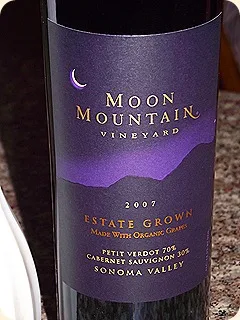
Moon Mountain Vineyard 2007 Petit Verdot-Cabernet Sauvignon, Sonoma Valley


When we read that there was a closeout of Moon Mountain Vineyard wine we burned up the keyboard placing an order to stock up on these elegant wines. We were introduced to Moon Mountain a couple years ago by tasting team member Ace of Bass. He brought a Moon Mountain Cabernet to a tasting and it entranced the group – being rich, fruit forward, and sporting a super long finish.
We recently popped open the first of our Moon Mountain shipment, the 2007 Petit Verdot – Cab blend. Petit Verdot is best known as a blending grape in Bordeaux wines, but we have recently been appreciating it as a lead player. In a twist, Cabernet Sauvignon is a supporting player at 30% of the blend.
The wine is a luxurious deep purple with a dark berry bouquet. The name of the winery conjures up a bit of mystery and the wine delivers with flavor notes of plum and dark cherry. The wine has structure, but the mountains of the moon are smooth and this PV follows suit. Vanilla and spice flavor notes elevates this wine above a typical Sonoma Cabernet.
The grapes are estate grown and organic, adding to the allure. The winery is located on the Sonoma side of Mount Veeder at about 2,000 feet. The winery and vineyards were sold to Diageo Wines. It’s unclear if wine like this will be produced in the future. We certainly hope so. We nabbed this wine at an unbelievable price of $12.99.
Like a full moon, this vino beamed forth with radiant goodness. We’re ready to launch a moon mission again very soon.
Rating: 4.5 of 5  Value: 5 of 5
Enhanced by Zemanta

Thursday, July 28, 2011

Virginia Winery Visit: WBC 11 Bus Visits Flying Fox Vineyard

Part of the magic of the Wine Bloggers’ Conference is the mystery bus tour. You load onto a bus for a trip to two or three wineries and vineyards never quite knowing where you’re going until you are underway. At WBC11 in Charlottesville, Green Dragon and I took what surely must have been the best tour of all visiting three standout Virginia wineries.

As we got underway, we learned that we were headed to Nelson County, which has only one stoplight, but 10 wineries and at least three breweries. It’s all part of the effort to build the “agri-tainment” industry.We were getting a chance to visit a small, medium and large winery.

Our first stop was the Flying Fox Vineyard tasting room. in Afton. This is a micro-sized tasting room that has a stated limit of 15 persons – but it packs a lot of luscious flavor into its friendly confines. The winery is family run, by Lynn Davis and Rich Evans, and has 6.5 acres of vineyard. This is small production winemaking at its best.

We started the tasting with two Viogniers, a 2009 from the Shenandoah Valley AVA and a 2010 from the
Monticello AVA. The Shenandoah had beautiful citrus flavor notes and a dry finish. Surprisingly the 2010 was a bit mellower and had a smidge more residual sugar. The growing season was very hot and the grapes were harvested early.

Viognier is Virginia’s signature grape and the state’s best can stand proudly with the top whites in the US.

Flying Fox taught us an important lesson about Virginia wine: You will be surprised by the high quality of Virginia reds.

We then moved into a vertical flight of Petit Verdot. The Petit Verdot I’ve tasted has mostly been used as a blending wine, with 5% here and 7% there. The 2006 Monticello Petit Verdot flipped the tables with a blend of 75% Petit Verdot and 25% Merlot. It was a true eye-opener with rich mouthfeel with a smooth approach and mellow finish. This was one of the standout wines of the trip and we bought a bottle of this.****+

Continuing on we moved to the 2007 Petit Verdot***, which I judged to be earthier than the ‘06. While still a delight, it was ranked below the other two PV. The finale for the vertical tasting was the 2008 100% Petit Verdot. This is barrel-aged for two years. This had a bit more firmness and a captivating sour cherry flavor. This is also a winner.****

On the tasting sheet two additional wines were listed as “and if time permits…” Well, I was going to be sure that time did indeed permit. since they were two small production Cabernet Francs. The first was the 2007 Shenandoah Valley Cab Franc with 88% Cab Franc and 12% Petit Verdot. The grapes for this vintage came from Lynn’s sister’s vineyard when a contract fell through right before harvest. The grapes were smaller
berries on small clusters. 195 cases were produced. The wine is a pure expression of Cab Franc with no bite whatsoever. ****+

The 2008 Monticello Cabernet Franc is estate grown with 90% Cab Franc and 10% Petit Verdot. This had more tannins and more noticeable pepper than the ‘07, but is indeed awesome. ****

We finished with a bonus tasting of Flying Fox Red, a red blend geared for the sweeter palate.

Flying Fox is a great experience for wine lovers. You'll be rewarded with well made boutique wine and stunning scenery.

Technorati Tags: ,,
Enhanced by Zemanta